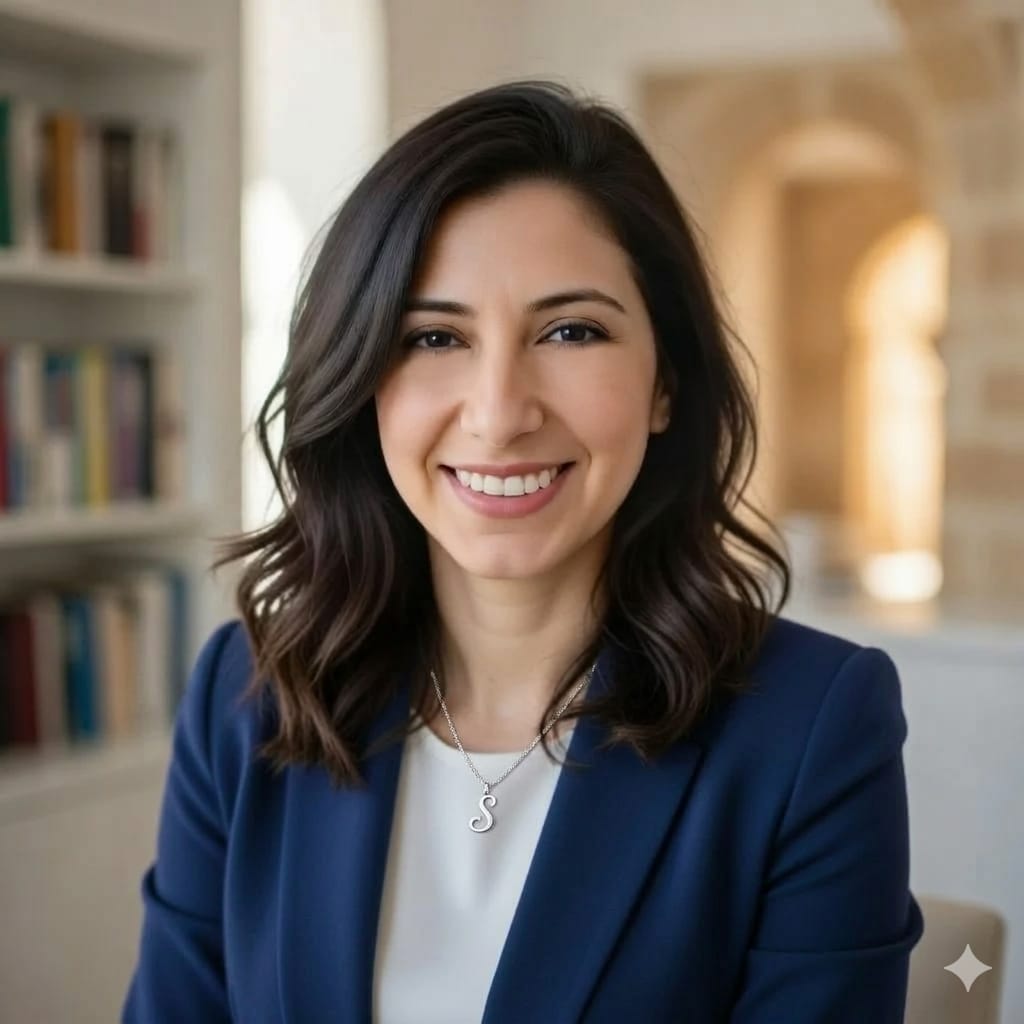
 Dr Suzanne Kobeisse
People sometimes ask me where my French comes from. It is a fair question, because the answer is not the obvious one. I did not grow up in Paris. I was not raised in Lyon or Bordeaux. My French comes from Beirut, and from a Lebanese educational tradition that treated the language with a kind of reverence I have never quite found replicated anywhere else.
Let me explain what that actually means.
Two languages, one childhood
In Lebanon, French is not a foreign language. It is woven into the fabric of daily life in a way that is difficult to describe unless you have lived it. At home, my family spoke Arabic, Lebanese Arabic specifically, which is its own vivid, expressive world. But the moment I stepped into school, the language shifted entirely. We were educated in French from a young age in the lycée tradition: literature, history, science, mathematics, all taught in French and held to a French academic standard.
What this meant in practice was that I did not experience French as something I was learning. I experienced it as something I was living inside, alongside my Arabic, from childhood. The two languages sat side by side in my head, each with its own texture, its own emotional register. Arabic for warmth and family. French for rigour and ideas. Neither was more mine than the other.
There is a particular kind of confidence that comes from that kind of immersion. Not arrogance, but ease. The ease of someone who knows that French is a home, not a destination.
What the lycée gave me
The French educational tradition I was taught in is uncompromising in the best possible way. Grammar is taken seriously. Precision matters. You are expected to construct an argument in writing with care and clarity, not just communicate roughly. The French word exigence captures it: a quality of demanding exactness, of holding yourself to a standard.
But alongside that rigour there was always culture. We read French literature, we studied French history, we absorbed the rhythms of a language that has been used to write some of the most beautiful prose in the world. I read Camus before I read him in translation. I encountered Moliere as something vital rather than something dusty. That shaped the way I think about what French teaching should do.
It should not just produce people who can conjugate verbs. It should produce people who understand why the language is worth knowing.
Coming to the UK, starting to teach
When I moved to the UK to pursue my doctorate, I arrived carrying that French inside me: fluent, near-native, shaped by both the rigour of formal education and the warmth of a bilingual upbringing. What I found here was a very different relationship with the language. Students who had studied it for years at school but still felt entirely lost when a French person spoke to them at normal speed. Textbooks that taught an oddly formal, slightly stilted version of French that real Parisian conversations do not always resemble.
I started teaching privately, initially just to help a few people around me. But the more students I worked with, the clearer it became: the gap between how French gets taught and how it actually works in the world is enormous, and it is not the students' fault.
French opened every door for me as a child. My job now is to open that same door for my students, not just show them where the door is and hand them a grammar book.
So that is what French Your Way is. It is my attempt to share the French I actually grew up with: confident, warm, culturally grounded, and unafraid of the gaps between the textbook and real life. I teach metropolitan French, the French of Paris and Brussels and international contexts, with the Lebanese warmth and informality that I think makes language learning feel less like a performance and more like a conversation.
What this means for my students
When a student sits down with me for the first time, I am not reading from a syllabus. I am drawing on a life spent inside this language. If you want to understand why French people seem curt when they are not being rude, I can explain that. If you want to know which version of tu and vous (the informal and formal "you") to use in a meeting, I know the real answer rather than the theoretical one. If you want to feel what it sounds like when French is spoken by someone who loves it, I can give you that too.
I teach beginners, people returning to a language they once knew, professionals who need French for work, students preparing for GCSE. The approach shifts depending on what someone needs. The spirit behind it does not.
That spirit came from growing up with two languages in Beirut, and from a school system that believed French was worth taking seriously. I am grateful for it every day, and I hope some of it comes through in every lesson I give.